- The Launch Dock
- Posts
- THE LAUNCH DOCK

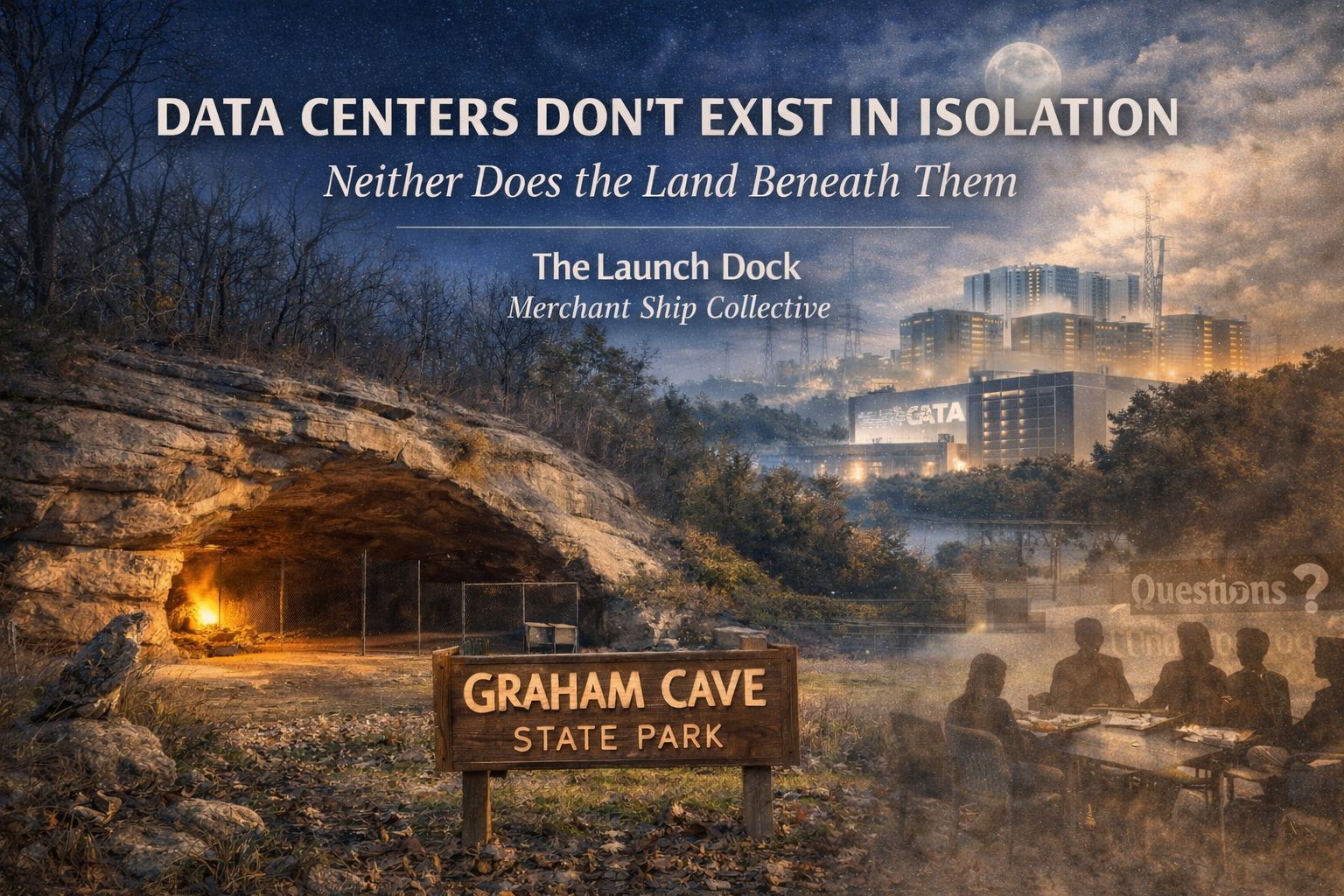
How Data Centers Reshape Land, Ecology, and Governance Long Before Construction Begins
Some Places Cannot Be Replaced
Not all land is interchangeable.
Some places carry ecological memory.
Some carry cultural meaning.
Some carry responsibility.
When development arrives near protected land, the question is no longer whether growth is legal.
It is whether growth is compatible with stewardship.
And whether decisions were made with full awareness of what stands to be altered—permanently.
When Industrial Scale Meets Protected Land
Proposed large-scale development near New Florence does not exist in isolation. It sits within proximity of land explicitly preserved for conservation, education, and historical integrity, including:
Graham Cave State Park — a site of archaeological significance, ecological preservation, and public heritage
Beth Winter Prairie — a remnant Missouri prairie used for education, conservation, and ecological restoration
Danville Conservation Area — protected land supporting wildlife, watershed health, and public access
These areas were preserved precisely because Missouri has already lost more than 99% of its original prairie ecosystems.
Once disrupted, they do not regenerate on industrial timelines.
Environmental Impact Is Not Just Footprint — It’s Pressure
Large data centers affect surrounding land even when boundaries are respected.
Common secondary impacts include:
Thermal load altering nearby microclimates
Light pollution disrupting nocturnal wildlife and migratory patterns
Noise pollution from continuous cooling systems
Hydrological stress through altered runoff and aquifer drawdown
Habitat fragmentation reducing conservation buffer effectiveness
Expansion pressure through phased growth
None of these require environmental violations to occur.
They emerge from scale.
Conservation as Branding vs. Conservation as Boundary
One of the least discussed dynamics in modern development is reputational adjacency.
When industrial projects sit near conservation land, schools, or public nature trails, they benefit indirectly from the language of sustainability, stewardship, and education—even if their operations are fundamentally extractive.
This is not inherently deceptive.
But it becomes problematic when proximity is used to imply alignment.
A prairie does not offset aquifer drawdown.
A trail sign does not mitigate industrial heat.
A sponsorship does not substitute for ecological limits.
A Hypothetical — But Familiar — Governance Pattern
Consider a hypothetical rural community:
A member of a regional economic development committee helps advance site readiness
That same individual serves on a local school board
Their private business benefits indirectly from growth, contracts, or visibility
The school later receives infrastructure improvements, sponsorships, or partnerships tied to “community investment”
No laws are broken.
No votes are improperly cast.
No disclosures are missing.
And yet:
Influence compounds
Dissent becomes socially costly
Questioning feels disloyal
Outcomes feel inevitable
This is not corruption.
It is structural entanglement.
Why Schools Are Especially Sensitive Spaces
Schools are trusted institutions.
When economic development narratives intersect with education, risks emerge:
Normalizing industrial presence for future generations
Framing development as inevitable rather than debatable
Limiting critical inquiry under the banner of opportunity
Creating implicit pressure on educators and families to “get on board”
Education should expand questions—not narrow them.
Other Concerns Communities Rarely Hear About Early
Beyond land and water, large data center development raises additional long-term questions:
Energy lock-in prioritizing industrial loads over residential needs
Emergency services strain (fire suppression, hazardous materials response)
Decommissioning risk once facilities age out
Insurance and liability exposure decades later
Governance fatigue as complexity suppresses oversight
These are not speculative fears.
They are documented challenges in regions that approved similar projects years ago.
What Responsible Transparency Would Look Like
True transparency would mean:
Acknowledging proximity to protected land as a material factor
Explaining cumulative environmental pressure—not just compliance
Disclosing early coordination timelines
Separating educational institutions from promotional narratives
Inviting scrutiny before momentum makes it awkward
Transparency does not stop development.
It disciplines it.
Methodology
This article draws on conservation management principles, environmental impact frameworks, land-use planning standards, and publicly available economic development practices. No individuals or entities are accused of wrongdoing. Hypothetical examples are used to illustrate structural patterns. Readers are encouraged to review public records and conduct independent research.
Closing: Stewardship Is a Choice, Not a Label
Protected land exists because earlier generations chose restraint.
The question now is whether modern development will honor that inheritance—or quietly surround it until protection becomes symbolic.
Growth without reflection is not progress.
It is acceleration without direction.
And direction is still something communities can influence—if they are allowed to see the full map.
In solidarity,
Lyndsay LaBrier
Merchant Ship Collective
The Launch Dock
References
McLaren, J. D., Buler, J. J., Schreckengost, T., Smolinsky, J. A., Boone, M., van Loon, E. E., Dawson, D. K., & Walters, E. L. (2018). Artificial light at night confounds broad-scale habitat use by migrating birds. Ecology Letters, 21(3), 356–364. https://doi.org/10.1111/ele.12902
Shehabi, A., Smith, S. J., Sartor, D. A., Brown, R. E., Herrlin, M., Koomey, J. G., Masanet, E., Horner, N., Azevedo, I. L., & Lintner, W. (2016). United States data center energy usage report (LBNL-1005775). Lawrence Berkeley National Laboratory. https://eta.lbl.gov/publications/united-states-data-center-energy
Siddik, M. B., Shehabi, A., & Marston, L. (2021). The environmental footprint of data centers in the United States. Environmental Research Letters, 16(6), 064017. https://doi.org/10.1088/1748-9326/abfba1
Missouri Department of Conservation. (n.d.). Graham Cave State Park. https://mdc.mo.gov/discover-nature/places/graham-cave-state-park
Missouri Department of Conservation. (n.d.). Danville Conservation Area. https://mdc.mo.gov/discover-nature/places/danville-conservation-area
Missouri Department of Conservation. (n.d.). Danville Glades Natural Area. https://mdc.mo.gov/discover-nature/places/danville-glades-natural-area
U.S. Department of Energy. (2020). Energy and water use in data centers. https://www.energy.gov/eere/buildings/data-centers