- The Launch Dock
- Posts
- THE LAUNCH DOCK

Public Health in the Age of Data Centers
Infrastructure, Power, and the Systems That Shape Our Lives
Is Your Health Really Just “Your Responsibility”?
We are taught that health is personal.
What we eat.
What we drink.
How much we move.
How well we sleep.
And yes — those things matter.
But public health has never been only about individual choices.
It is about the conditions people are forced to live inside.
Clean water.
Breathable air.
Safe infrastructure.
Emergency response capacity.
Environmental stability.
Long-term exposure.
Public health, by definition, exists to prevent disease, prolong life, and promote well-being at the population level (World Health Organization [WHO], 2023).
Which raises an uncomfortable question:
What happens when leaders prioritize industrial speed over human systems?
And more directly:
What happens when economic development is approved without fully accounting for its health consequences?
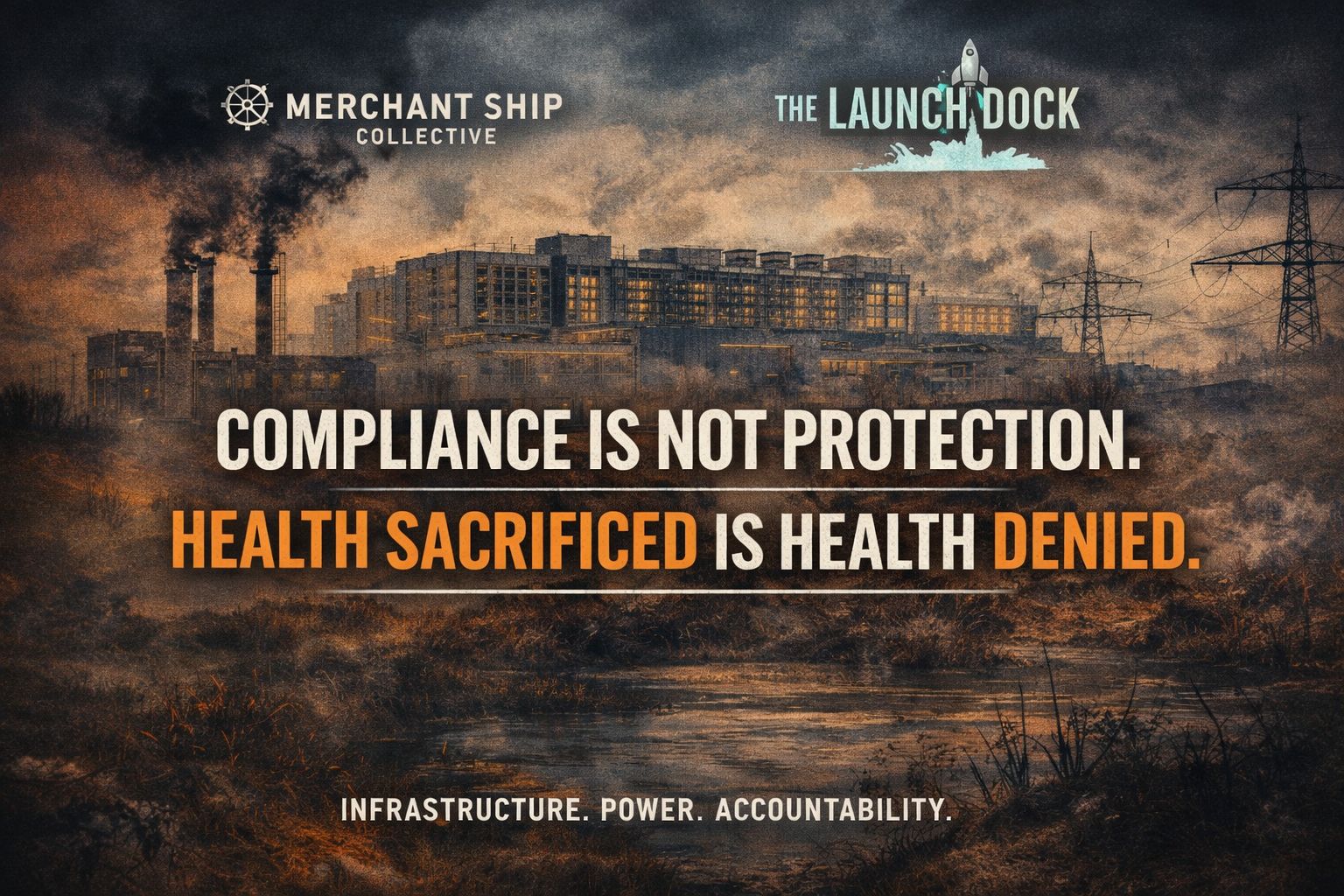
Compliance Is Not Protection
There is a difference between protecting public health and checking a box.
Most large industrial projects technically “comply” with regulations.
That sounds reassuring.
It often isn’t.
Because health protections are applied in fragments — at different stages, by different agencies, under different assumptions about what is being built.
And timing matters.
A lot.
Stage One: Site Certification & Industrial Zoning
When land is prepared or certified as an industrial site, reviews usually focus on:
land use classification
basic environmental constraints
access to utilities
zoning compatibility
The project is described broadly:
“Industrial development.”
“Advanced manufacturing.”
“Commercial infrastructure.”
Not:
“A hyperscale data center operating 24/7 with industrial cooling systems, diesel backup generators, lithium-battery arrays, and continuous high-volume water withdrawal.”
So the health analysis is minimal.
Because the description is minimal.
Stage Two: Project Approval
Later, when the actual data center proposal appears, agencies review it under narrow categories:
air-quality permits
water-use thresholds
building codes
fire codes
noise ordinances
Each agency evaluates only its slice of the system.
No one is required to ask:
“What does this entire operation do to human health over 10, 20, or 30 years?”
Instead, they ask:
Does this generator meet emissions limits?
Does this building meet code?
Does water use stay under the legal cap?
Does noise stay under ordinance levels at the property line?
Each answer can be “yes.”
And the total harm can still be real.
That is how compliance replaces protection.
Why This Structure Fails Public Health
Health impacts are cumulative:
long-term air pollution exposure
groundwater depletion
chronic noise stress
emergency-response strain
chemical exposure
heat-island effects
Regulations are siloed.
A project can be:
legally permitted
procedurally approved
technically compliant
and still increase:
asthma rates
cardiovascular disease
water insecurity
disaster risk
long-term community health costs
No single agency owns those outcomes.
So no single agency is forced to prevent them.
The Illusion of Safeguards
Communities are told:
“It meets regulations.”
What that usually means:
“It fits inside rules written decades ago for much smaller, lower-intensity development.”
Most zoning and health codes were written before:
hyperscale computing
continuous industrial cooling
grid-scale battery storage
AI-driven energy demand
climate-level water stress
The rules did not anticipate the scale.
The approvals pretend they did.
Why Early Process Determines Everything
Once land is:
certified
zoned industrial
infrastructure-connected
financially committed
public health becomes a “mitigation issue.”
Not a deciding factor.
Instead of:
“Should this be here?”
The question becomes:
“How do we manage the damage?”
That shift happens quietly.
And permanently.
If health review happens only after land, utilities, and tax incentives are locked in, then public health is not being protected.
It is being accommodated.
That is not prevention.
It is paperwork.
Facts & Statistics: What the Evidence Already Shows
Air Pollution
Diesel backup generators at data centers are major sources of nitrogen oxides (NOx) and fine particulate matter (U.S. Environmental Protection Agency [EPA], 2022).
Long-term exposure to NO₂ increases asthma incidence and cardiovascular disease risk (WHO, 2021).
Water Consumption
Hyperscale data centers commonly consume 1–5 million gallons of water per day for cooling (U.S. Department of Energy [DOE], 2023).
Groundwater over-extraction increases contamination risk and drought vulnerability (U.S. Geological Survey [USGS], 2022).
Noise & Chronic Stress
Chronic industrial noise exposure is associated with elevated blood pressure, sleep disorders, and increased risk of heart disease (Centers for Disease Control and Prevention [CDC], 2020).
Emergency Response
Lithium-ion battery fires can burn for days, release toxic gases, and require specialized hazmat suppression techniques (National Fire Protection Association [NFPA], 2022).
Rural fire districts average significantly longer response times and lower staffing levels than urban departments (U.S. Fire Administration [USFA], 2021).
Regulatory Gaps
Many private industrial projects avoid comprehensive federal environmental review under NEPA by proceeding through fragmented local permitting processes (U.S. Government Accountability Office [GAO], 2014).
What This Means for Communities
Public health is not a line item.
It is the system that absorbs what economic development leaves behind.
When leaders treat industrial approval as an economic decision instead of a health decision, the costs don’t disappear.
They relocate:
To hospitals.
To groundwater.
To emergency responders.
To families.
To future tax bills.
To children growing up next to infrastructure never designed for neighborhoods.
A Word About AI, Technology, and Reality
Using AI to organize research does not mean consenting to industrialization.
You can support technology and still defend land, water, safety, and local control.
Those are not contradictions.
They are boundaries.
Technology should serve communities.
Not overwrite them.
Call to Action
If your community is facing a data center or large industrial project:
Ask:
When was the site certified?
Who applied?
What water-use modeling exists?
Who funds emergency infrastructure?
What happens if the project stalls?
Which nonprofits or authorities hold land?
Where are the full contracts?
What long-term health studies were conducted?
Demand:
Health impact assessments before zoning changes
Infrastructure funding before approvals
Emergency planning before construction
Transparency before incentives
Read filings.
Track timelines.
Follow the money.
Vote intentionally.
And reject the lie:
“You’re too late.”
You’re not.
Closing
Public health is not optional.
It is not a technicality.
It is the foundation every economy stands on.
And systems that quietly trade it away are not modern.
They are reckless.
In solidarity,
Lyndsay LaBrier
Merchant Ship Collective
The Launch Dock
References
Centers for Disease Control and Prevention. (2020). Environmental noise and health. https://www.cdc.gov
Environmental Protection Agency. (2022). Diesel engines and emissions. https://www.epa.gov
National Fire Protection Association. (2022). Lithium-ion battery safety and fire risks. https://www.nfpa.org
U.S. Department of Energy. (2023). Data center energy and water use report. https://www.energy.gov
U.S. Fire Administration. (2021). Rural fire department staffing and response times. https://www.usfa.fema.gov
U.S. Geological Survey. (2022). Groundwater depletion and contamination risk. https://www.usgs.gov
U.S. Government Accountability Office. (2014). National Environmental Policy Act: Little oversight of environmental review exemptions. https://www.gao.gov
World Health Organization. (2021). Air quality guidelines: Global update 2021. https://www.who.int
World Health Organization. (2023). Public health definition and scope. https://www.who.int