- The Launch Dock
- Posts
- The Launch D
The Launch D
Your Vote Doesn’t Matter—That’s the Lie the System Depends On

Lyndsay LaBrier
April 05, 2026
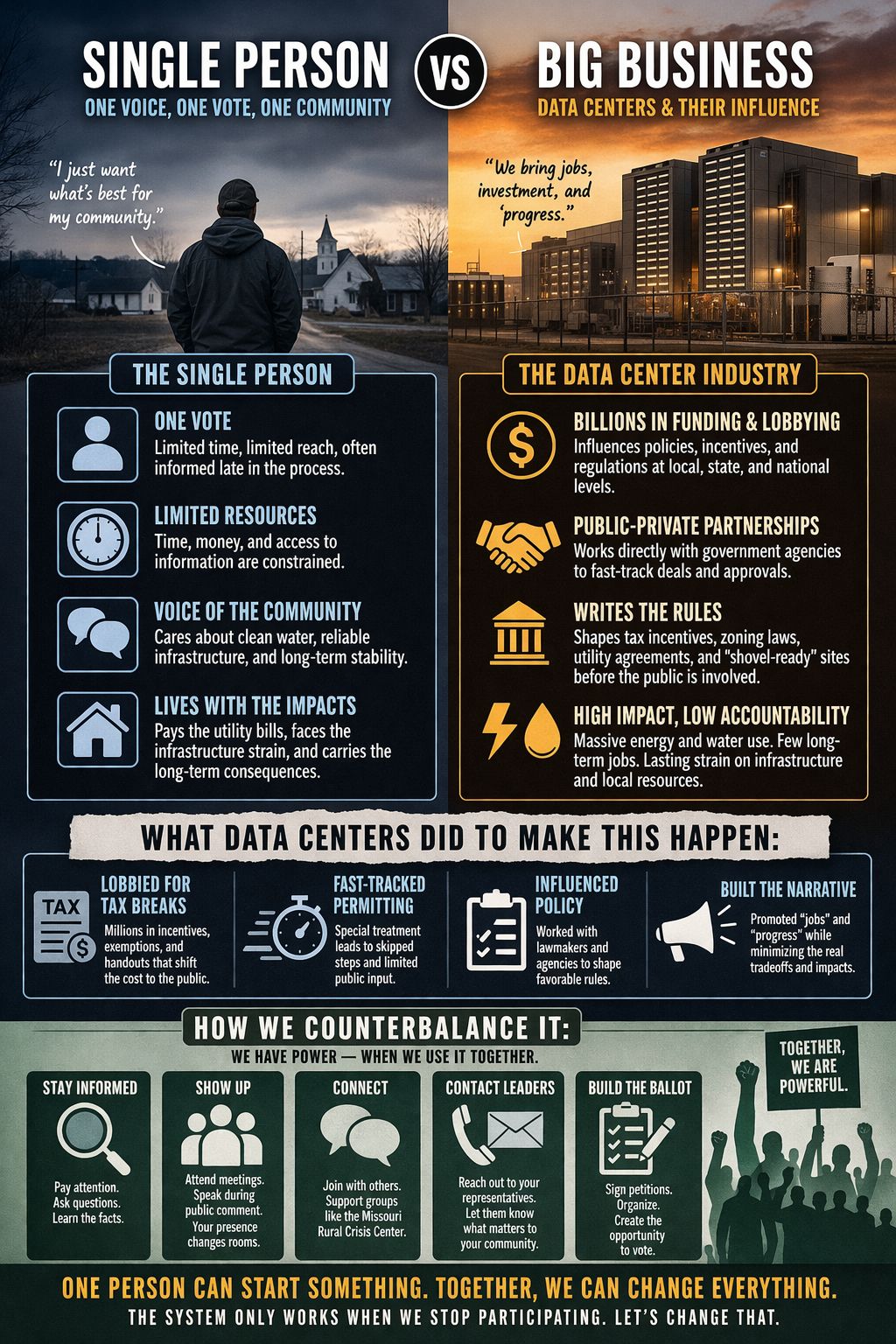
The Power Was Never Missing—It Was Just Moved Earlier
The Lie That Keeps the Machine Running
You’ve heard it before.
“Your vote doesn’t matter.”
“It won’t change anything.”
“They’re going to do what they want anyway.”
That belief didn’t spread by accident.
It’s reinforced—over time, through systems that benefit when people disengage. Systems influenced by decision-makers, consultants, and industry voices that help shape how large-scale projects move forward—and how they’re communicated to the public.
Because when people believe they have no power, they stop asking questions.
And when people stop asking questions, decisions move faster, approvals get easier, and fewer obstacles stand in the way of large-scale deals.
That’s not coincidence.
That’s design.
How These Deals Actually Happen
Projects like data centers don’t just appear.
They move through systems—ones most people never see, and ones that have been shaped over time alongside the very industries that benefit from them.
It begins with agencies like the Missouri Department of Economic Development working with regional partners to identify and prepare land.
These are labeled:
“certified sites”
“industrial zones”
“shovel-ready locations”
Which sounds like opportunity.
But what it often means is:
The groundwork is done before the public is meaningfully involved (Missouri Department of Economic Development [DED], n.d.).
From there, public-private partnerships align public resources with private companies. Incentives are structured. Infrastructure is planned. Zoning begins to shift.
How the Rules Got Written—A Real Example
This system didn’t happen overnight.
The expansion of data centers across the United States has been supported by years of policy changes at the state and local level, often shaped alongside the very companies building them.
Companies like Amazon Web Services, Google, and Microsoft have worked within—and helped influence economic development frameworks across multiple states.
This has included:
Tax exemptions on data center equipment and energy use
Fast-tracked permitting processes
Pre-certified industrial sites
Utility agreements designed for high-volume users
For example, states like Virginia have offered broad tax incentives specifically for data centers, contributing to large-scale expansion (Joint Legislative Audit and Review Commission [JLARC], 2022).
Over time, those decisions became standard practice.
And once something becomes standard…
it stops being questioned.
Language vs. Reality
This is where influence becomes harder to see.
You’ll hear:
“This is good for jobs”
“This is necessary for growth”
“This is how we’ve always done it”
But rarely:
how few long-term jobs are created
how much energy and water is required
what long-term infrastructure strain looks like
who carries the risk if systems are pushed too far
Data centers are associated with high energy demand and resource use (U.S. Department of Energy, 2023).
And when language goes unquestioned—
so do the decisions behind it.
Why Data Centers Are Different
Data centers are often framed as innovation.
But they come with tradeoffs:
extremely high electricity consumption
significant water usage for cooling
limited permanent job creation
increased pressure on local infrastructure
These impacts are well-documented in national and global research (International Energy Agency [IEA], 2023).
One Vote Can Stop It—But Only If It Makes It to the Ballot
A lot of people ask:
“Why can’t we just vote no on this?”
And the truth is—
You can.
But only after it’s forced onto a ballot.
Because in Missouri, projects like data centers are not automatically put to a public vote.
They move through:
zoning decisions
development agreements
economic boards
Not ballots.
And when people believe their vote wouldn’t matter anyway, there’s even less pressure to change that system.
Because a system doesn’t have to block participation—
if it can convince people not to try.
What It Looks Like When People Actually Step In
Right now in Missouri, people are organizing.
Groups like the Missouri Rural Crisis Center are working with community members to increase awareness, encourage participation, and bring attention to the impact of large-scale development decisions.
This includes:
community meetings
public engagement
legislative conversations
And for those who want to get involved, that can look like:
attending local meetings
connecting with organizations already doing this work
participating in outreach or advocacy efforts
Not every detail of that work is public—and it shouldn’t be.
But one thing is clear:
Change happens when people step in early.
This Is Also Happening at the State Level
There is active discussion within the Missouri House of Representatives.
HB 3362 proposes oversight related to large-scale utility users, including data centers.
It has already been heard in committee.
Which means:
The outcome is still being shaped.
And that means people still have time to:
contact their state representatives
ask questions
share concerns
How Something Actually Gets to a Ballot in Missouri
Missouri allows citizens to participate in lawmaking through initiative and referendum processes (Missouri Secretary of State, n.d.).
That means:
citizens can propose measures
citizens can challenge decisions
and with enough support, issues can be placed on a ballot
But this requires:
petitions
signatures
coordination
and public engagement
Ballots don’t just happen.
They are built.
Before You Vote This Tuesday
If you are voting this week, pause for a moment.
Not to be told what to vote for—
But to think about what matters.
Ask yourself:
Who benefits from the decisions being made?
Who carries the long-term cost?
Was the public meaningfully included—or informed late?
Are you being given the full picture—or just the headline?
Does this create short-term activity or long-term stability for the community?
Voting is powerful.
But informed voting is what actually creates change.
You Don’t Have to Be Part of an Organization to Have Power
Organizations matter.
But they are not the only path.
You can:
attend a meeting
ask a question
request public records
speak during public comment
contact your local officials
reach out to your state representatives
And sometimes that’s how it starts.
What You Can Do Right Now
Pay attention to local agendas
Show up to meetings
Ask direct questions
Follow legislation like HB 3362
Contact your state representatives and senators
Connect with organizations already doing this work
Share what you learn
You don’t have to do everything.
But you do have to do something.
Because presence changes rooms.
Resources to Get Started
If you’re not sure where to begin, start here:
Find Your Representatives
Missouri House: https://www.house.mo.gov
Missouri Senate: https://www.senate.mo.gov
Understand Ballot & Petition Processes
Missouri Secretary of State: https://www.sos.mo.gov
Get Involved with Community Organizations
Missouri Rural Crisis Center: https://morural.org
(Sign up for updates, events, and ways to get involved)
Find Local Government Meetings
Search: “[your city] city council agenda”
Check your local Planning & Zoning meeting schedule
The Truth Most People Aren’t Told
It’s not that your vote doesn’t matter.
It’s that:
By the time you’re asked to vote,
the outcome has already been shaped by those who showed up earlier.
Final Thought
No one is going to hand communities a ballot and ask:
“Do you want this here?”
That moment only exists if people create it.
And the idea that your voice doesn’t matter was never meant to reflect reality—
It was meant to keep things moving without resistance.
Because once people realize they were never powerless…
The system has to answer to them.
Closing
In solidarity,
Lyndsay LaBrier
Merchant Ship Collective
The Launch Dock
References
International Energy Agency. (2023). Data centres and data transmission networks. https://www.iea.org
Joint Legislative Audit and Review Commission. (2022). Data center incentives and economic impact in Virginia. https://jlarc.virginia.gov
Missouri Department of Economic Development. (n.d.). Certified sites program. https://ded.mo.gov
Missouri Secretary of State. (n.d.). Initiative and referendum process. https://www.sos.mo.gov
U.S. Department of Energy. (2023). Energy demand in data centers. https://www.energy.gov